insight
Why Your Payslip May Look Different in 2026
Published on 31 August 2026 - Reading time: 10 - 13 mins
Understanding the Impact of India’s New Wage Definition
India's labour law framework has been consolidated into four Labour Codes, introducing a revised definition of wages that may require employers to review and restructure salary components. As a result, some employees may notice changes to the way their salary is presented on their payslip.
Table of Contents
At a Glance: What’s Changing?
If your salary currently includes a large proportion of allowances and a relatively low basic salary, your employer may need to rebalance the components of your pay.
You may notice:
- Higher basic pay
- Lower allowance components
- Increased Provident Fund (PF) contributions
- Higher Gratuity benefits
- Possible changes to take-home pay
- Potential tax implications depending on your individual salary structure
Not sure what all this means? Watch this short video for a simple explanation of how the revised wage definition could affect your salary structure, payslip components and statutory benefits.
Understanding the 50% Wage Rule
Under the revised wage definition, Basic Pay, Dearness Allowance (DA), and Retaining Allowance (where applicable) should constitute at least 50% of total wages.
If these components currently account for less than 50% of your salary, employers may need to increase the basic salary portion and reduce certain allowances to comply with the requirements.
What does that mean for you?
You may see:
|
Before |
After |
|---|---|
|
Lower Basic Pay |
Higher Basic Pay |
|
Higher Allowances |
Reduced Allowances |
|
Lower PF Contributions |
Higher PF Contributions |
|
Lower Gratuity Accrual |
Higher Gratuity Accrual |
Your overall compensation may remain largely unchanged, although deductions and benefit calculations could differ.
A Simple Example*
Current vs Revised Salary Structure
|
Component |
Current Salary Structure (Basic <50%) |
Revised Salary Structure (Basic >=50%) |
|
Basic Pay |
20,000 |
30,000 |
|
HRA |
15,000 |
10,000 |
|
Other Allowances (OA) |
25,000 |
20,000 |
|
PF Deduction (@ 12%) |
2,400 |
3,600 |
|
Gross Salary (Basic+HRA+OA-PF) |
57,600 |
56,400 |
In this example:
- Gross salary reduces slightly
- Basic pay increases.
- Some allowances decrease.
- PF and gratuity benefits increase because they are linked to basic pay.
*Illustrative example only.
What your new payslip could look like
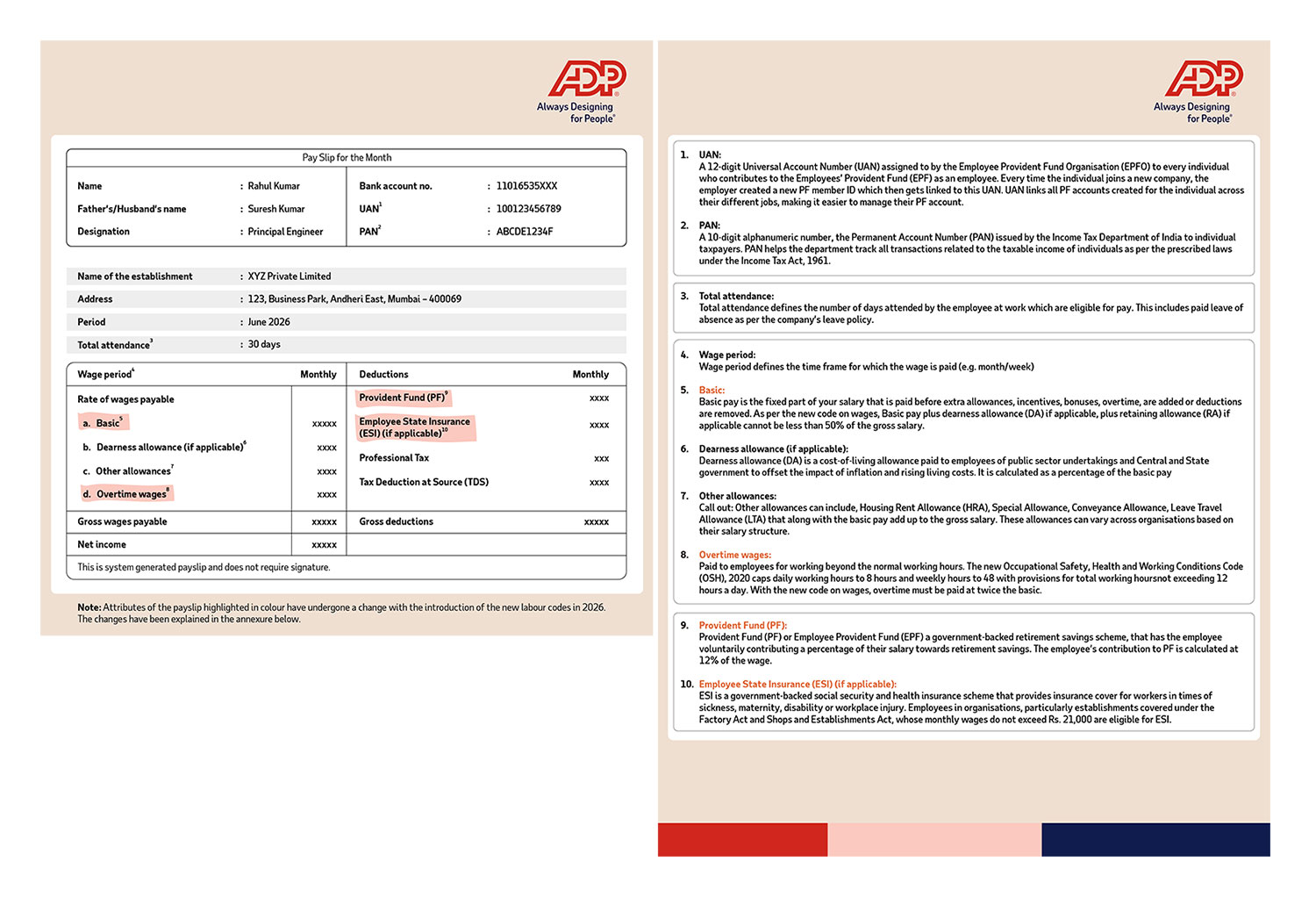
Other key considerations:
Provident Fund (PF)
A higher basic salary can increase both employee and employer PF contributions, helping build greater retirement savings over time.
Gratuity
Because gratuity calculations are linked to wages, a higher basic salary may result in a larger gratuity benefit over time.
Employee State Insurance (ESI)
Employees covered by ESI may see changes to deductions if wage components are restructured.
Overtime Pay
For eligible employees, overtime pay may increase where wage calculations are affected by a higher basic salary.
Income Tax
Changes to salary components and statutory deductions can influence taxable income. The actual impact will depend on your individual tax calculation.
Frequently Asked Questions
Will my take-home pay decrease?
It may change slightly if PF deductions increase. The actual impact depends on your salary structure.
Will my annual salary or CTC increase?
Not necessarily. Many employers may rebalance salary components while keeping overall compensation broadly unchanged.
Will everyone be affected?
No. The impact depends on your current pay structure and eligibility for statutory benefits.
Why are allowances being reduced?
Allowances may be adjusted to ensure that qualifying wage components meet the required threshold under the revised wage definition.
Are these changes beneficial?
Higher basic pay can result in increased PF accumulation and gratuity benefits, supporting long-term retirement security.